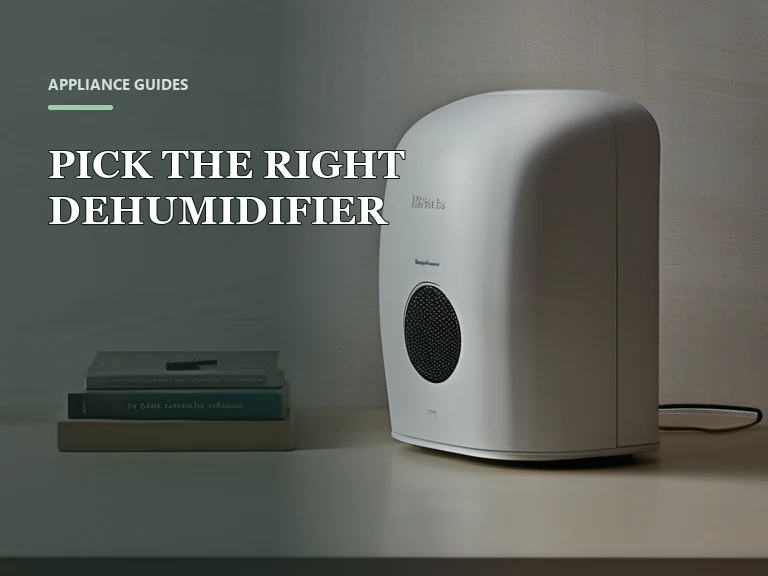
A dehumidifier collects moisture from indoor air, but it does not repair a leak, drainage fault, or persistent water intrusion. EPA advises keeping indoor relative humidity below 60%, ideally between 30% and 50%, where practical. Use a hygrometer to understand the room before buying and investigate recurring wetness at its source. Consider showers, cooking, damp basements, and seasonal conditions, while distinguishing routine humidity from a building problem. If you see persistent leaks or extensive dampness, seek building or professional guidance. An appliance may be one part of moisture management, not proof that the underlying cause is resolved.
Choose capacity for conditions, not just floor area
Dehumidifier capacity is commonly stated as the amount of water it can remove in a period, often pints per day in U.S. materials. The correct size depends on room size, moisture load, temperature, drainage, and how damp the space is—not square footage alone. ENERGY STAR offers guidance and current certified product information; use the maker’s specifications for the exact room conditions and model. A damp basement may need different capacity than a mildly humid bedroom of similar size. Compare ratings measured under the same test conditions and do not assume that two “50-pint” products from different eras or standards are directly comparable.
Compare energy use and expected operating hours
ENERGY STAR explains that Integrated Energy Factor (IEF) measures litres of water removed per kilowatt-hour; a higher IEF indicates greater efficiency under the rating’s test conditions. Real household cost depends on local electricity price, moisture conditions, thermostat or humidistat setting, and operating hours. Estimate cost from the model’s rated energy use or input power only when the source provides it, and state the assumptions. If usage changes by season, calculate a range. Also consider the energy used by continuous operation versus automatic humidity control and the convenience of a pump or drain hose. Do not promise a particular bill reduction without measured household data.
Check drainage, placement, and upkeep
Emptying a bucket can be inconvenient and may stop operation when full. Check tank capacity, auto-shutoff, hose drainage, pump availability, and whether a floor drain is nearby. Follow the manual for required slope and hose placement. Measure the unit, confirm it fits through doorways, and leave the recommended clearance around air inlets. Clean the filter at the stated interval and inspect the bucket and drain according to instructions. Check the lowest operating temperature because some models may not perform as expected in a cold room. Noise, control readability, and handle design can make a practical difference in a space used every day.
Compare warranty and service beyond the box
Record model number, capacity, efficiency rating, warranty duration, exclusions, and available service locations. Verify whether a warranty requires registration or proof of purchase. A longer warranty is useful only when coverage and repair channels are clear. Look for the current ENERGY STAR listing rather than relying solely on a logo in an old retailer description. Compare parts such as filters, drain hoses, and pumps, as well as how easy the manufacturer makes replacement. Product availability and prices vary by market and date, so this guide makes no model ranking or price claim. Save the specification page and manual so you can revisit the comparison after a season of use.
Apply the guide to your situation
Use a model comparison sheet rather than a ranked list. Record exact model and market, specification source and date, room or home constraints, regular consumables, maintenance steps, warranty, and known unknowns. Compare like with like: the same rating method, room conditions, operating mode, and intended task. A headline capacity or marketing feature cannot predict the experience in every home. Verify that replacement parts are available before buying and estimate recurring costs with current local prices. State clearly when the article relies on published specifications; do not describe specification research as personal testing.
Common questions
What humidity should I aim for?
EPA advises below 60% relative humidity, ideally between 30% and 50%, where practical. Room conditions vary; use a hygrometer and address the moisture source.
Does a dehumidifier solve mould?
It can help manage humidity but does not fix a leak or remove a material problem. EPA guidance emphasizes moisture control; investigate and repair the source.
Is higher IEF better?
ENERGY STAR describes higher IEF as more efficient under the applicable test conditions. Compare current specifications and remember that real usage and local electricity rates affect cost.
Practical next step
Use this guide as a starting point: check the exact label, model, contract, food-safety condition, or official program page for your circumstances, then save the source and date used. If a critical detail remains unclear, contact the responsible manufacturer, retailer, utility, or government agency before making a decision. Recheck time-sensitive information before acting because products, policies, and availability may change.
Sources and further reading
Sources checked November 19, 2026. These links support the topic and are not endorsements.